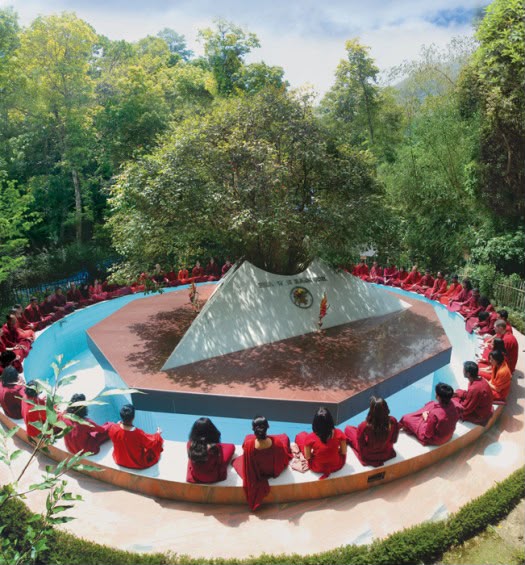
The increasing global conflict and violence have deeply concerned and saddened all of humanity. The world is facing a serious crisis due to the ongoing Russia-Ukraine war in Eastern Europe, the Israel-Gaza war in the Middle East, the America-Iran war, and rising political tensions between various countries.
Every day, a large number of people are losing their lives, while millions are forced to live difficult lives as injured, homeless, and disabled. Countless children are suffering from war. War weakens social harmony, damages the environment, and has severely impacted the global economy.
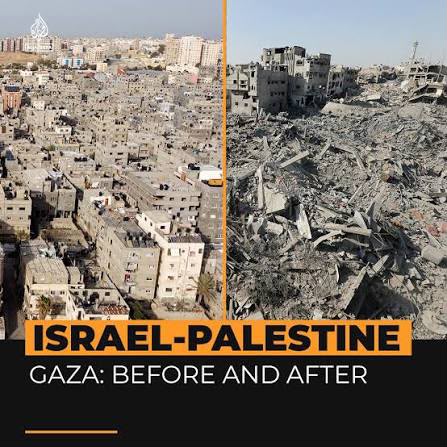
According to the Global Peace Index, over 181,000 people lost their lives in various global conflicts in 2025. Globally, an average of approximately 8 billion US dollars (1.2 trillion Nepali Rupees) is spent daily on the military sector. The current situation suggests that rising tensions between major powers have increased the threat of widespread war.
In many conflicts, political and diplomatic initiatives have not yet yielded expected results. At such times, when political efforts and diplomatic dialogues become ineffective, we must turn back to our inner consciousness and existence to find a path to solutions. In such a destructive and challenging situation, a simple prayer, meditation, and positive thought offered with deep love, compassion, and pure feelings by an ordinary citizen or a conscious individual holds transformative power.
The causes of the ongoing wars and conflicts in the world today are, in one way or another, the suppressed frustrations, anger, hatred, and animosity, along with other negative thoughts and feelings within the human mind. When such negative thoughts and feelings accumulate continuously in people's minds, over time they erupt as collective dissatisfaction and tension, taking destructive forms every 10-15 years. However, through conscious effort, practice, meditation, and prayer, such thoughts can be transformed towards positive perspectives and emotional balance.
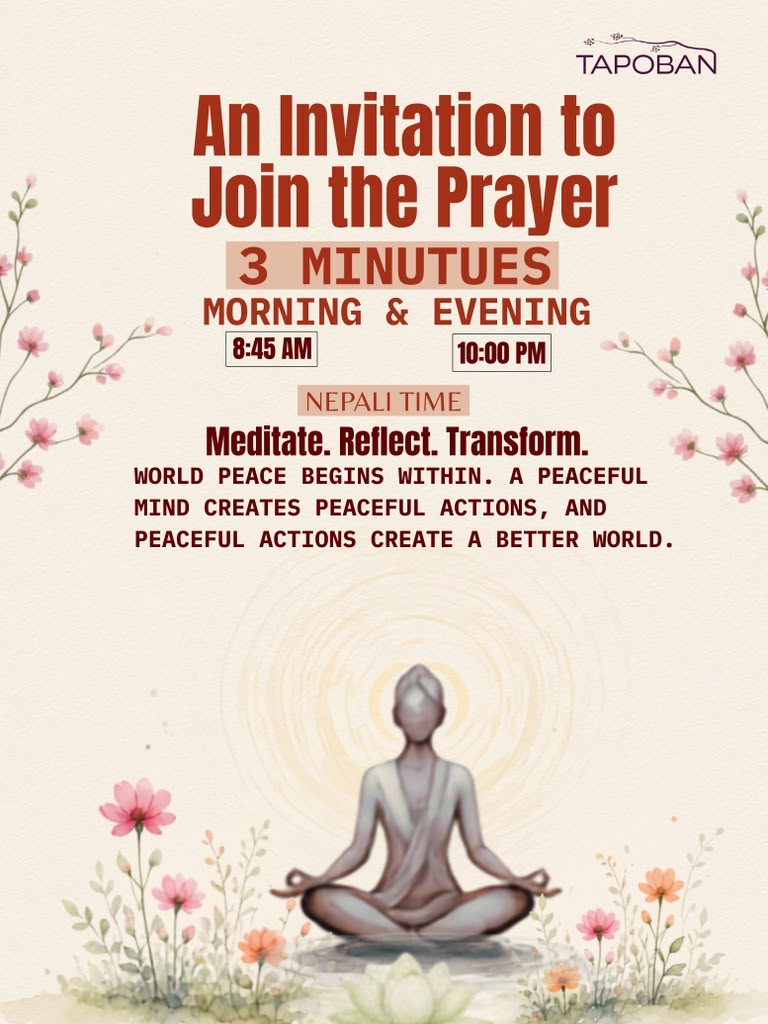
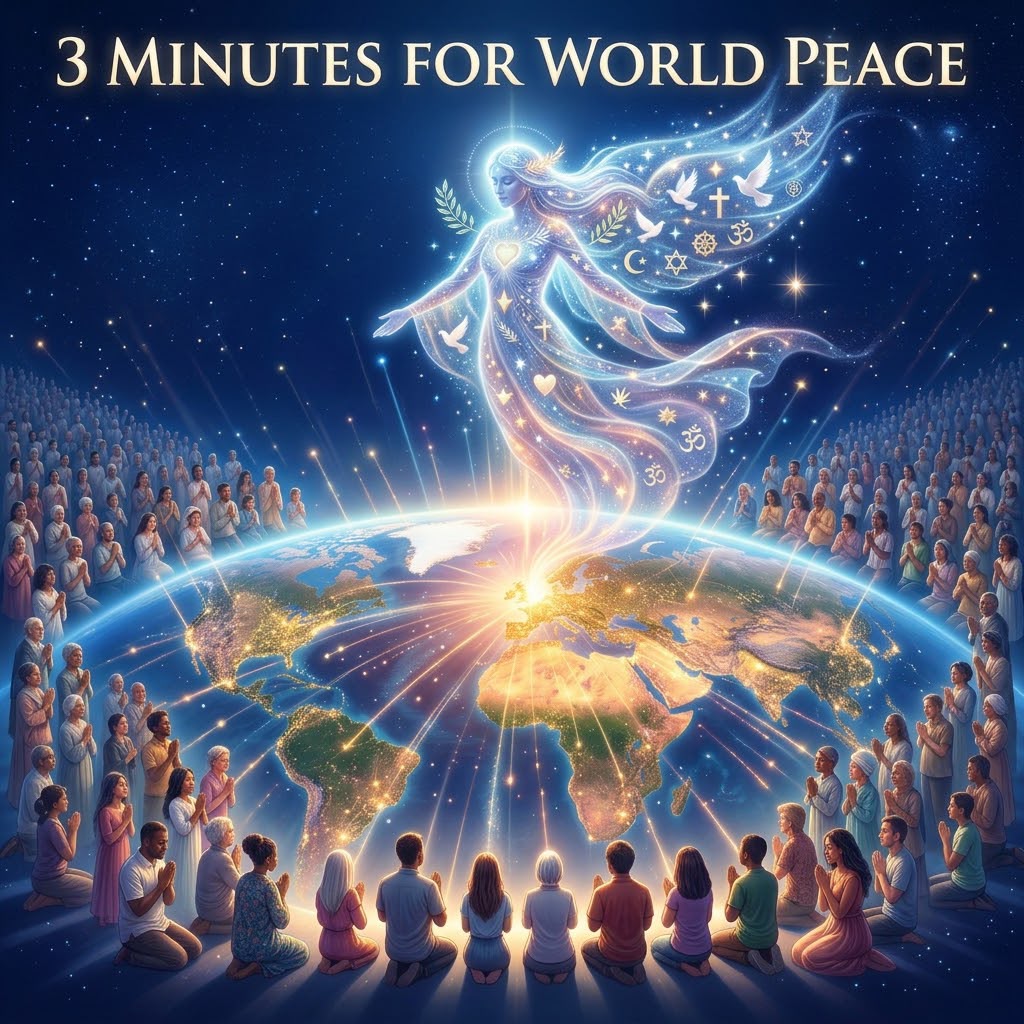
Therefore, to give concrete form to this conscious effort, we have launched the '3 Minutes for World Peace' campaign from Osho Tapoban. A humble beginning is to collectively pray for three minutes each day after meditation in the morning and evening.
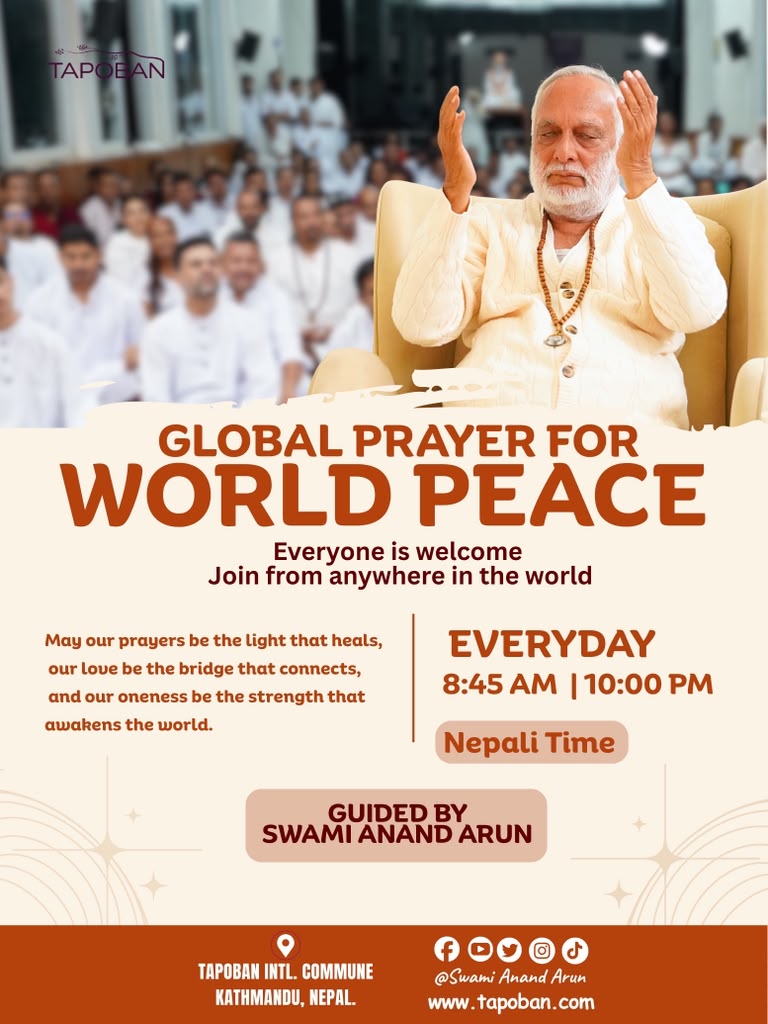
Our aim is for this campaign to reach conscious individuals worldwide, not just within Nepal. At Tapoban, about two hundred people daily, and thousands of practitioners directly connected with Osho Tapoban, collectively pray for three minutes twice a day for the end of war and violence and for world peace.
We wish for this to not be limited to Osho's disciples but adopted by all conscious and peace-loving people. The main objective is not just to run a campaign for a short period but to continue it as a part of life in the long term. Such prayer brings immediate change not only externally but also in the life of the person praying. When a conscious person prays with deep love and compassion, their mind becomes peaceful, and compassion develops. Moreover, when we pray selflessly for the welfare of the world, we have the grace and blessings of existence.
The large number of people killed, injured, and disabled today due to war and violence are not just statistics; they are severe assaults on human sensibility. In such a situation, irresponsible actions by political leadership have pushed human consciousness further back. The current era is the age of science, technology, and information.
Information technology has brought the world closer like a family. Today, science and technology are continuously advancing in the search for life on other planets; but ironically, on this very Earth, people are losing their lives due to war, violence, and unrest. This era has also become an age of mental deviation, self-forgetfulness, and constant agitation. The misuse of politics and religion has further complicated this.
According to the latest statistics from the World Health Organization (WHO), approximately 1.1 billion people worldwide—that is, about one in every seven people—were affected by mental disorders in 2021, and according to WHO's latest report for 2025, over 1 billion people worldwide are affected by mental health problems. Therefore, it is necessary to sow the seeds of peace in human consciousness. Without peace and wisdom in the heart, even the development of science and technology has become a tool for destruction. Meditation and prayer are simple and conscious efforts that a conscious person can undertake.
Our saints have spoken extensively about the power of thought and have devised various meditation techniques. Swami Khaptad Baba, who realized the subtle nature of thought through his practice, expressed the secret of thought power in his famous book 'Vichar Vigyan' (Science of Thought) thus—'Thoughts travel at a speed many times faster than the speed of light (300,000 kilometers per second).' Humans constantly have 2,000 to 3,000 thoughts per hour. Thoughts have their own colors, smells, and effects. Being extremely subtle, they cannot be seen by our eyes, but no one can escape their influence. When we focus with concentration on a single thought or emotion, our attention and resolve deepen.
The 'Reiki' method, which is very popular today for physical and mental healing, is also a vivid example of how we can heal diseases from anywhere in the world through our thoughts and feelings. Russian woman Nina Kulagina could also bend spoons and move small objects with the power of her mind without even touching them. There are many such examples in the world. Therefore, our thoughts are more influential than we think, especially when they are repeated frequently in the mind. Our thoughts are as effective as our words.
Some may feel that the conflicts and violence happening in various parts of the world are not directly related to our country. However, humanity is not limited by religion, borders, or nations. We are not suggesting that our small prayer will immediately stop the war, but it can positively influence the reduction of political and criminal violence in any country to some extent. Just as collective hatred and fear create an environment of violence, a collective resolve of compassion, love, and peace plays a significant role in orienting people's thoughts, behavior, and social relationships towards peace.
A study on world peace meditation held in Hyderabad, India, from December 2023 to January 2024, with the participation of over 10,000 people, noted a significant decrease in the overall trend of political violence in Palestine, Myanmar, and Syria. The study showed an overall reduction of 29.2 percent in violent incidents from December 2023 to January 2025.
Similarly, a study on a group of 'Transcendental Meditation' (TM) in Washington D.C. in 1993, with the participation of about four thousand people, reported a reduction of up to 23.3 percent in violent crimes such as murder, rape, and assault.
A study on a TM group in Jerusalem in August-September 1983 showed a correlation with reduced deaths in the Lebanon war on days when the number of participants in the group was high. One analysis of the study reported that war-related deaths decreased by approximately 76 percent during periods of high participation. This research was published in the 'Journal of Conflict Resolution' at Yale University in 1988.
Nepal is a spiritual country. We have an open heart, a tradition of meditation and prayer, and a rich spiritual culture. This consciousness of peace, compassion, and coexistence is what the world needs today.
Therefore, setting aside three minutes in the morning and three minutes in the evening out of twenty-four hours is not particularly difficult for the end of war. Our sages also established the tradition of praying for the welfare of the world in difficult times. Modern research shows that meditation can positively impact the human brain, stress, and emotional balance. Let us not limit this to a single day or a single study. If we can connect more and more people to this campaign daily, it can contribute to creating an environment of peace, compassion, and harmony in a world afflicted by war and violence.
The seed of conflict and violence is first sown in the human mind; therefore, the real prevention of war and violence must also begin with the transformation of human consciousness. Nuclear bombs and modern destructive weapons are a curse to today's humanity. Because a small technical error, impulsive behavior by wrong political leadership, or a minor mistake due to mental derangement can turn this world into a desert in moments.
Praying for three minutes every morning and evening may seem like a small effort individually. But when many people pray daily with the same positive emotion, love, and compassion, it can collectively develop consciousness of peace and harmony. Such positive resolve contributes to reducing the unrest and negativity prevalent in society through people's thoughts and behavior.
Existence has given us a beautiful Earth full of nature, but today this very Earth is heading towards decline due to violence, conflict, and destruction. The approximately 8 billion US dollars (1.2 trillion Nepali Rupees) spent daily on the military sector worldwide—the expenditure of just two days of which is equivalent to the annual budget of a country like Nepal—if a large portion of it could be invested in the education, health, and poverty alleviation of underdeveloped and war-affected countries, how beautiful could the world become?
Finally, let us remember the prayers that our sages have been offering for the welfare of the world for ages. I urge everyone to join this campaign for the end of war and violence. This is not just a small prayer, but the beginning of a new culture of peace and compassion. It sends the message that we are sensitive to the world and care for it—'We care for the world.'
Sarve bhavantu sukhinah.
Sarve santu niramayah.
Sarve bhadrani pashyantu.
Ma kashcid duḥkhabhāg bhavet.
“May all be happy, may all be free from illness, may all behold auspiciousness, and may no one suffer from sorrow.”